Future-Proofing Classic and Collector Cars
A Panel of Experts Weighs in on Breaking the Stigma and Embracing Vehicle Electrification
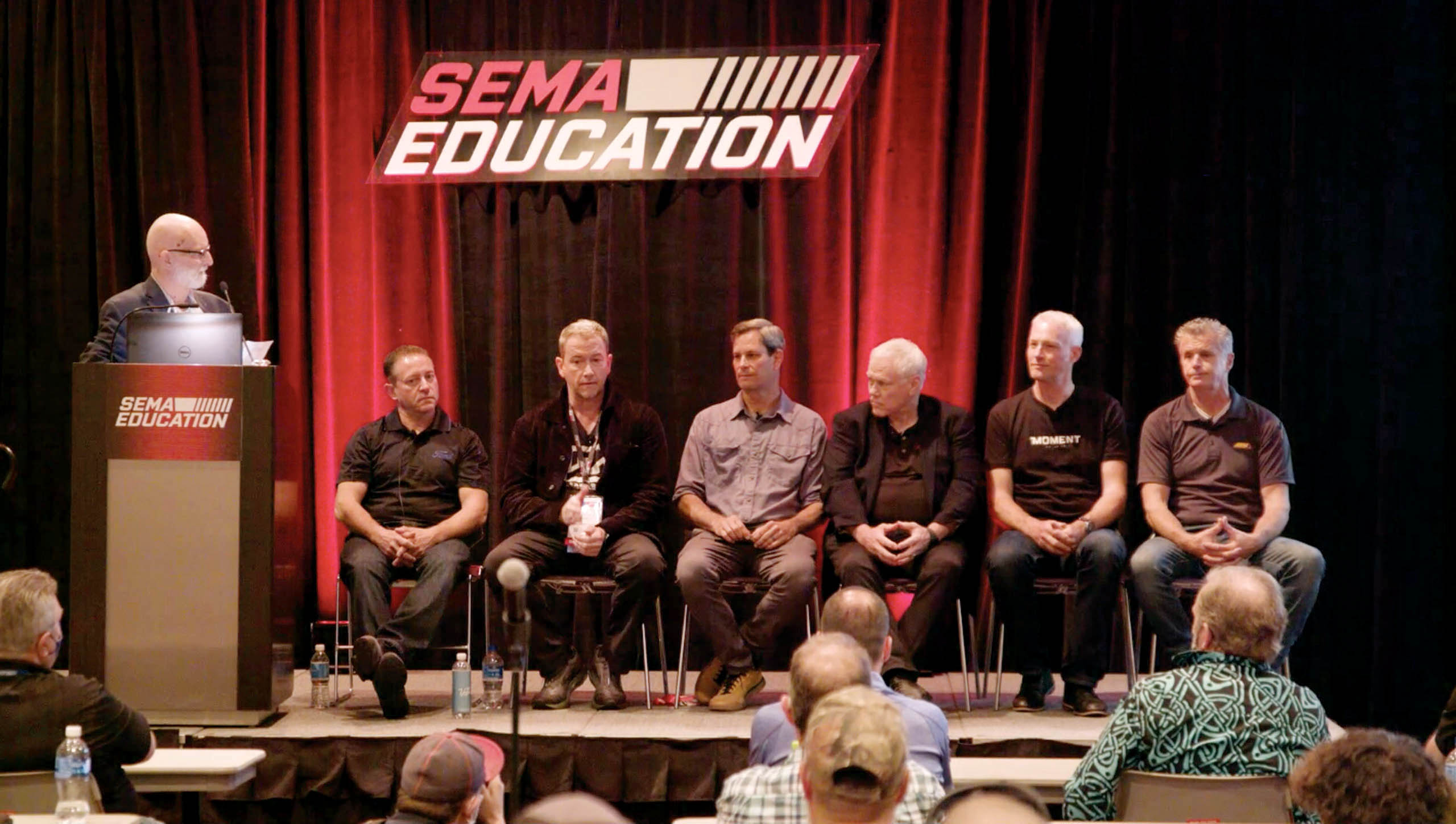
They’re more reliable, cleaner, and they pack a punch. So why all the hesitancy surrounding electric vehicles (EVs)? Misconceptions regarding range, V8 growl nostalgia and battery weight are three reasons, according to an expert panel who addressed the topic at last year’s SEMA Show.
The SEMA Show education session entitled “Future-Proofing Classic and Collector Cars” delved deeply into this concept. Moderated by Larry Edsall of Classiccars.com, the panel featured Michael Bream, chief executive of EV West; Marc Davis, CEO of Moment Motor Co.; Craig Jackson, CEO of Barrett-Jackson (booth #21427); Kirk Miller, vice president of AEM Performance Electronics; Dave Pericak, director of Ford Future Electric Vehicles; and Adam Roe, CEO of Zero Labs Automotive.
Here’s what the experts had to say last year, edited for length and clarity.
Edsall: Why can’t we just assume that we can drive our petroleum cars forever? Why are you convinced that we have to convert to electric?
Roe: Two reasons. One is reliability. The classics are hard to support. They break down a lot. For some people here, that’s the fun part. But for most people, it’s not fun. If you look at EPA data before there were measured emissions, these cars are 4,000 to 5,000 times worse in many cases than new cars.
Bream: There’s a safety aspect as well. The drivability is much improved when you’re adding power steering, power brakes, modern systems and climate control. We’re all up here because we love classic cars, and an electric modification gives them longevity.
Miller: The ability to do an EV conversion without molesting that valuable classic car is impressive. You can look at a lot of the classic cars that these guys here have built. They’ve done an amazing job of preserving the shell, and they’ve made it so that the internal-combustion engine (ICE) components can be preserved, so if at some point they want to revert back to ICE, the opportunity is there.
Davis: If you’re hacking these cars up and making them different than they used to be, you lose the aftermarket. You lose the ability to continue to enhance and build the car for the future. There are a lot of reasons we do this. Yes, ecologically, but we love classic cars and that classic driving experience. The connection we have with these cars is visceral. We can maintain all of that and the love and joy we get while driving these cars by essentially replacing what gets them down the road.
Miller: You can talk about a Volkswagen bus that has 35 hp, which is frightening to get on the freeway. Now you put a 120hp electric motor in it, and it becomes fun to drive.
Edsall: People used to take the old engines out of their classic cars and put in crate motors and upgrade the brakes. The car looked the same, but it was now a restomod. It was controversial. The purists thought it was stupid, but Craig Jackson was a champion of that. Is this the next step?
Jackson: We have to embrace what the next generation likes. A lot of them love the look of the car but not necessarily how it drives. So restomods came along, and they’ve gone to such a level to make them drive super nice, but they still look stock. I think the next evolution is to build an electric restomod.
Pericak: We just introduced a new electric crate motor. It’s the actual motor that comes out of the Mach-E GT. To show what you can do with it, we put it in an F-100. The electric motor has 634 lb.-ft. of instantaneous torque. That’s what we all dream about.
Edsall: There’s a hesitancy with some people with new electric vehicles because of range. Are you finding that with your customers who are doing conversions?
Roe: We have to assume that you’re not getting a classic electric car because you’re trying to win the Nürburgring or drive across the country. If that’s your function, then there are a lot of other cars out there for that. When the first highways started opening up 100 years ago, people were trying to determine how far the average car needed to go in a day, and after about 50 years of highways, it was about 25 mi. Here we are today, and it’s still about 25 mi. We’re not going any further than we were on average.
Pericak: Range anxiety is a true thing, but there’s an education that has to happen around this because most people don’t drive the kind of miles that they think they drive. The battery technology is changing all the time, and you’ll be able to charge a lot faster.
Edsall: There’s a perception that this industry is dependent on leftover motors after Teslas crash. Why is that perception wrong? How is it changing?
Bream: The economics of it, you have these cars that are very expensive, they become for the most part undrivable, but a lot of the componentry is still good. We use that and the economics from it, and that drives what we’re doing.
Roe: There are thousands of parts that go into any car, but electric conversion, especially, is a mix of what you can find that’s available and what you have to salvage. There’s no perfect answer. Many shops do a good job of pushing as many parts as you need, but there’s still stuff missing. There’s always going to be a
transition.
Davis: This industry is at the fledgling stage. As companies like AEM bring in control systems, and companies like Cascadia bring motors to the market, we’ll no longer have to dig through the scrap pile and re-engineer Tesla parts. It will be a whole new world.
Miller: With EVs, we’re at the infancy. You want to be at the leading edge. From AEM’s perspective, we’re at the bleeding edge with the resources we’ve pumped into this technology. We are hemorrhaging. We have a huge conviction that this is part of our future.
Roe: It’s all about hooking up an electric motor to a transmission. But what you get when you put a high-output motor coupled to a system that was never designed to handle that, it’s like putting a rocket on a tricycle in some cases. It just can’t handle it.
Edsall: Say you’re at the SEMA Show and you have a customer who wants to electrify his classic car. What do you do?
Bream: I think you should be excited for the future. You’re getting into something that’s going to give your shop a lot of marketing and longevity. We’re not measuring carbon, we’re just trying to build very fast, high-performance electric vehicles, and the side effect is a cleaner environment.
Pericak: This is one of the reasons it’s so exciting. You always want more performance, but it came with a negative effect to the environment. Now it’s the reverse. You’re getting way more performance than you ever have in the past, and in a way that is responsible to the planet.
Edsall: Won’t people miss the sound of the exhaust?
Bream: Electric actually predates gas. We did a land-speed car this year at Bonneville, and people are surprised to know that the first six land-speed records were electric.
Davis: People are concerned that you’re going to lose the soul of the car, but once you take them for a ride in an electric car, they start to understand. It’s just the sound. You instantly forget about it when you get in the car, hit the pedal and that torque hits you.
Roe: From a behavioral perspective, nostalgia isn’t a remembrance of the past; it’s a misremembrance of the past. You’ve glorified and sanitized how you thought about the past and left out all the things you didn’t like. What you think you love in the past is a lie. The sound is more for peer-bonding. Your buddies like it, but you get over it pretty quickly because you tend to think that the sound of the car defines you as the man. Let’s find something else to define that.
Pericak: The visceral sound was an indicator of power. It’s going to be different for EVs—and we’re just scratching the surface of performance EVs. I don’t want to erase what it was before. Of course I love the sound of a V8, but it’s going to be different, and there will be different cues to determine how powerful something is.


